Do you feed your muse a diet of junk food or does she have a more refined palate? Does she have expensive tastes like Sharon Stone’s character in The Muse? Perhaps your muse is starving to death or has locked herself up and refuses to speak to you. Read on for how to keep her healthy and keep the creative inspiration flowing.
Most writers at one time or another encounter writer’s block, and it can feel debilitating. And it can last for weeks, months or even years. Sometimes when we get stuck on one project, we may give up and just refuse to write at all. Other times, upon finishing a project it seems that ideas for a new one just don’t flow.
“Adam was the only man who, when he said a good thing, knew that nobody had said it before him.”
Mark Twain
In the book “The Miracle Morning for Writers: How to Build a Writing Ritual That Increases Your Impact and Your Income,” Steve Scott and Hal Leonard talk about strategies for avoiding writer’s block as part of the principle for building a writing routine:
- Separate your editor’s brain and your writer’s brain into two activities.
- Build the idea-generation habit.
- Stop comparing yourself to famous authors.
- Avoid and prevent distractions.
Let’s talk about that second one, making idea generation a habit. How do you generate ideas? There are several ways suggested in the book:
- Write down your ideas.
- Free associate.
- Talk about firsts. (Your first kiss, the first time you drove a car, your first day of school, etc.)
- Write about a picture.
Later in the book, the third principle, “Track Your Brilliant Ideas,” suggests additional, specific ways of generating ideas.
- Do a lot of reading, at least five minutes daily: Read books about writing; about successful people; outside of your genre; in your genre; and magazines.
- Get out into the world: People-watch, exercise, listen to podcasts, and visit museums, parks, neighborhoods, landmarks, graveyards.
- Research your project: Interview experts, visit locations, use Google Maps, go to a library, use Wikipedia, take lessons related to your project, or watch instructional YouTube videos.
It reminds me of one of my favorite quotes from Anne Lamott, which I’ve also referenced in another post.
“…everything we need in order to tell our stories in a reasonable and exciting way already exists in each of us. Everything you need is in your head and memories, in all that your senses provide, in all that you’ve seen and thought and absorbed.”
Anne Lamott, “Bird by Bird: Some Instructions on Writing and Life”
To generate ideas, writers need to soak up information and experiences because you can use those to generate ideas for new projects, and for characters, scenes or chapters in your current project.
Is your story about a musician? A guitarist? Talking to someone who plays guitar, or watching an instructional video on YouTube can give you ideas for adding rich detail to your scenes. Or maybe you play guitar and can bring in your own experiences about how you feel when you play, how the strings sound when played a certain way, or how they feel against your fingers. I grew up on a small farm, so I drew on what it feels like to work in the garden under the blazing sun of a hot Georgia summer to add realistic description in my current project. I could describe it because I’d experienced it.
See, Anne Lamott was right!
Figure out which of these activities and experiences feeds your muse and do those, repeatedly and often. And draw upon what you already know.
For me, Miracle Morning for Writers reinforced something I had already experienced in my pursuit to write science fiction. I had a couple of ideas, including a nearly complete novella, but I knew that I should have a stable of ideas.
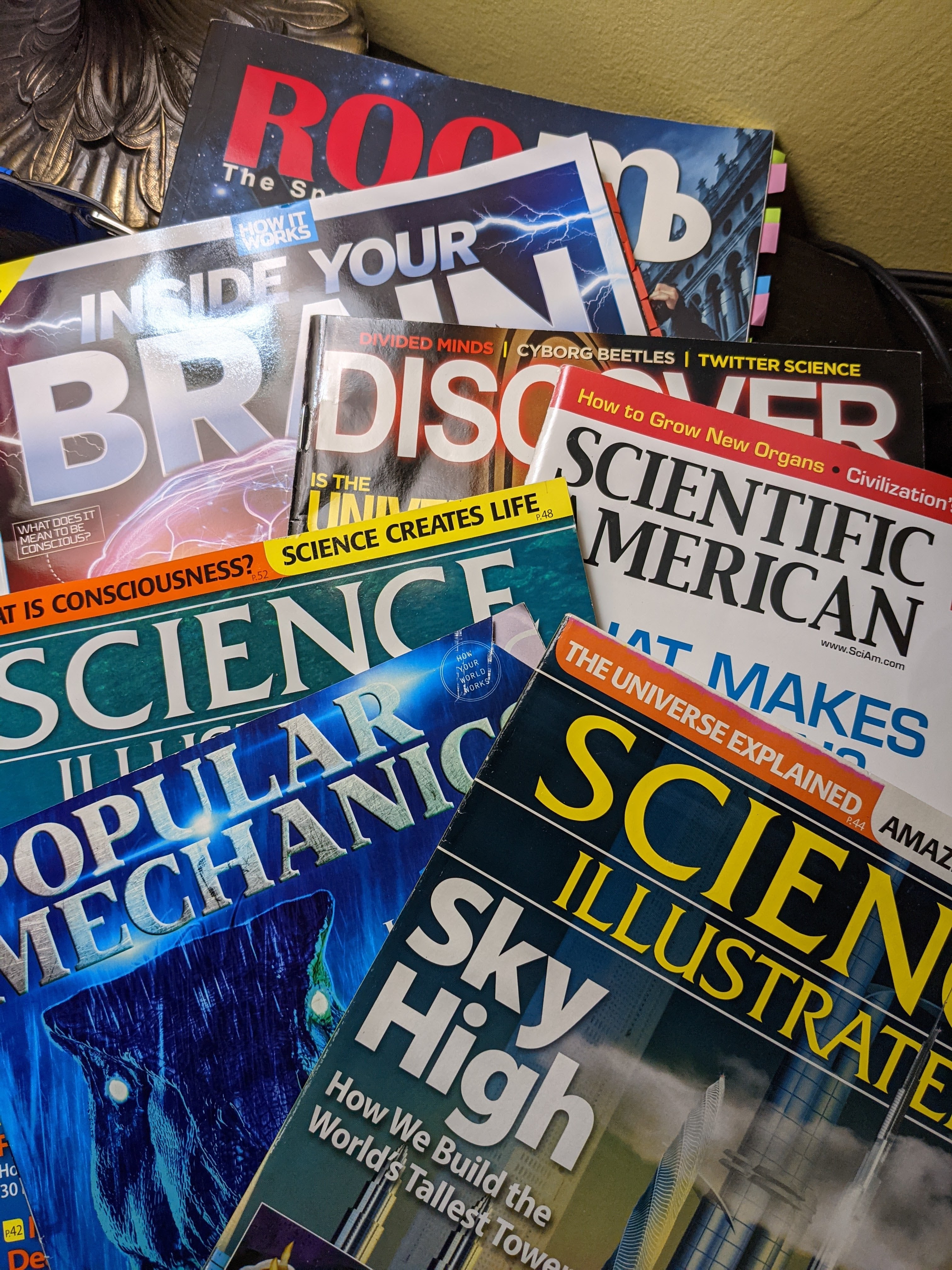
I bought a couple of science magazines, including Scientific American, Popular Mechanics, Science Illustrated, and Discover. I flip through these magazines, and jot down any ideas that might pop into my head. I also watch television programs about science; did you know that it “rains” diamonds on Neptune? Or that scientists have discovered quite a bit more water exists on the moon than previously believed? This last one caused me to rethink a short story, “The Misunderstood Water Thief,” based on the far side of the moon.
I remain open to ideas and keep a notebook or index cards handy for jotting them down. I’m deep into my novel project right now, but when it’s not my writing time, I still do those activities that feed my muse. Sometimes she gives me ideas for my current project, and sometimes she gives me ideas for others. But I always listen to her and dutiful write down what she’s telling me, because by keeping this dialogue open with her, I know that she also will inspire me as I sit down to write my novel.
Because that’s the ultimate inspiration for our muses — writing. Whether on a specific project or just free association, putting words on a page will inspire more words and more ideas.
What about you? Do you have a favorite way to inspire ideas? Have you used one of the above methods with success or does something else work better for you?
 Georgia Writer
My muse is extremely fickle and comes and goes as she pleases. I do many of the things you talk about, unfortunately, there’s no surefire way I’ve found yet to get the ideas flowing. But maybe that’s it. Not trying to always do the same thing but mix it up, create variety.