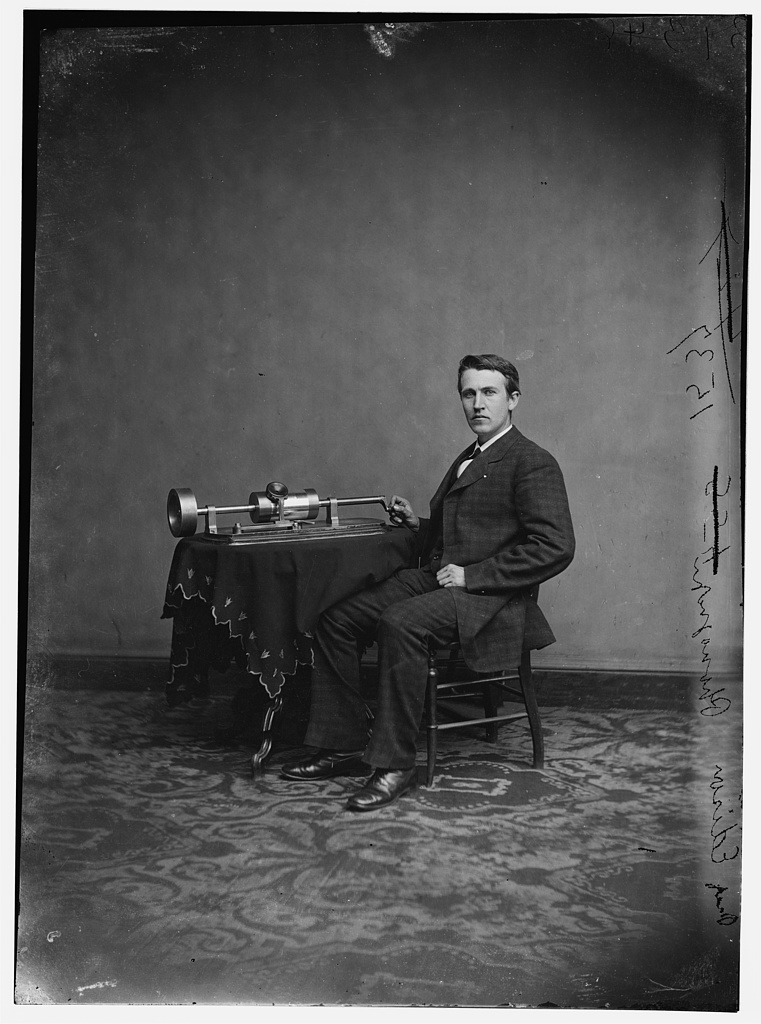
Most everyone has heard “Genius is 1 percent inspiration and 99 percent perspiration,” but do you know who said it? Thomas Edison, the inventor of the light bulb, the phonograph and 1,000 other inventions.
Here’s the rest of his famous quote: “Accordingly, a ‘genius’ is often merely a talented person who has done all of his or her homework.”
Edison did a lot of homework.
He spent as many as 18 hours a day toiling in his Menlo Park laboratory and was credited with more than 1,368 separate patents in his lifetime.
Edison had a personal philosophy that led him to accomplish in one life what most of us couldn’t do in 10:
“The first requisite for success is to develop the ability to focus and apply your mental and physical energies to the problem at hand – without growing weary. Because such thinking is often difficult, there seems to be no limit to which some people will go to avoid the effort and labor that is associated with it.”
What does an inventor have in common with a writer, or any creative person, for that matter? Both may invest hours upon hours of hard work and still fail to find success at the end.
Though Edison was talking about his own creative process as an inventor, writers should find truth in his words.
I once had the opportunity to sit in on a reading by a college student who was sharing a fantasy story he’s writing. Though he didn’t have any actual passages to read for the group, he spent a great deal of time explaining the world he was inventing, complete with its own creation mythology, culture, language and alphabet. He passed around pages freshly ripped from a spiral-bound notebook, covered on both sides with scribbled words and diagrams.
He shared his surprise upon coming to the realization that he was going to have to spend several weeks if not months creating the world in which his characters would exist before he even began spinning the story that would breathe life into them.
He sounded more than a bit discouraged.
A fellow student, not a writer, asked whether he just spent his time writing “or do you have a job, too?”
I stifled a laugh. Not because I thought it was a stupid question, but because I had shared his surprise when I first came to the same realization.
Whether you’re getting paid for it or not, writing is a full-time job — even when you’re not actually sitting down at a keyboard. And writers spend hours upon hours doing that.
I work on fiction writing in my spare time and I’ve often found my characters stealing into the isolated moments of my day. Some of my best ideas have popped into my head while I’m doing something mindless like weeding the garden or taking a shower.
My “paying gig” as a public relations professional in higher education revolves around writing and editing in a variety of formats. Even outside of the office, I sometimes find myself thinking about the opening to a story or a certain turn of phrase that will improve the script I’m working on.
Writing, whether you consider it a job, hobby, task or chore, takes a lot of hours out of your life because being creative doesn’t just happen. Like Edison said, it takes a lot of work.
But that hard work can be an enjoyable part of the process, not just a means to an end.
Take Edison, who said he gained as much enjoyment from spending 18 hours a day in his laboratory as his friends did playing golf.
So instead of lamenting that it may take months or even years to finish a poem, manuscript or essay, we writers should embrace the difficulty of our chosen task. After all, “Opportunity is missed by most people because it is dressed in overalls and looks like work.” (Edison again.)
And so I leave you with a final lesson from the Wizard of Menlo Park — my new favorite quote — about the potential that we all have:
“If we all did the things we are really capable of doing, we would literally astound ourselves.”
 Georgia Writer